Parking service · Mobile app · City mobility
Consumer App
Parking Marketplace Platform — Buenos Aires

Context
Buenos Aires is a dense metropolitan city with a large number of hidden private parking garages located in courtyards and underground spaces. At the time of launch, there was no reliable digital aggregation of these locations.
The goal was to create a digital layer over fragmented offline infrastructure.
Product Format
A single mobile application with multiple roles.
Driver
Search parking on a map
Filter by vehicle type (car, pickup, motorcycle)
View pricing
Book and (partially) pay
Parking Owner / Attendant
Create parking locations
Define number of available spots
Manage discounts
Scan QR codes at check-in
Admin
Moderate listings
Approve locations
Manage status lifecycle
Additionally, we implemented ownership verification via utility bills. This was not a “set of screens” — it was a multi-sided platform with supply lifecycle management.
My Role
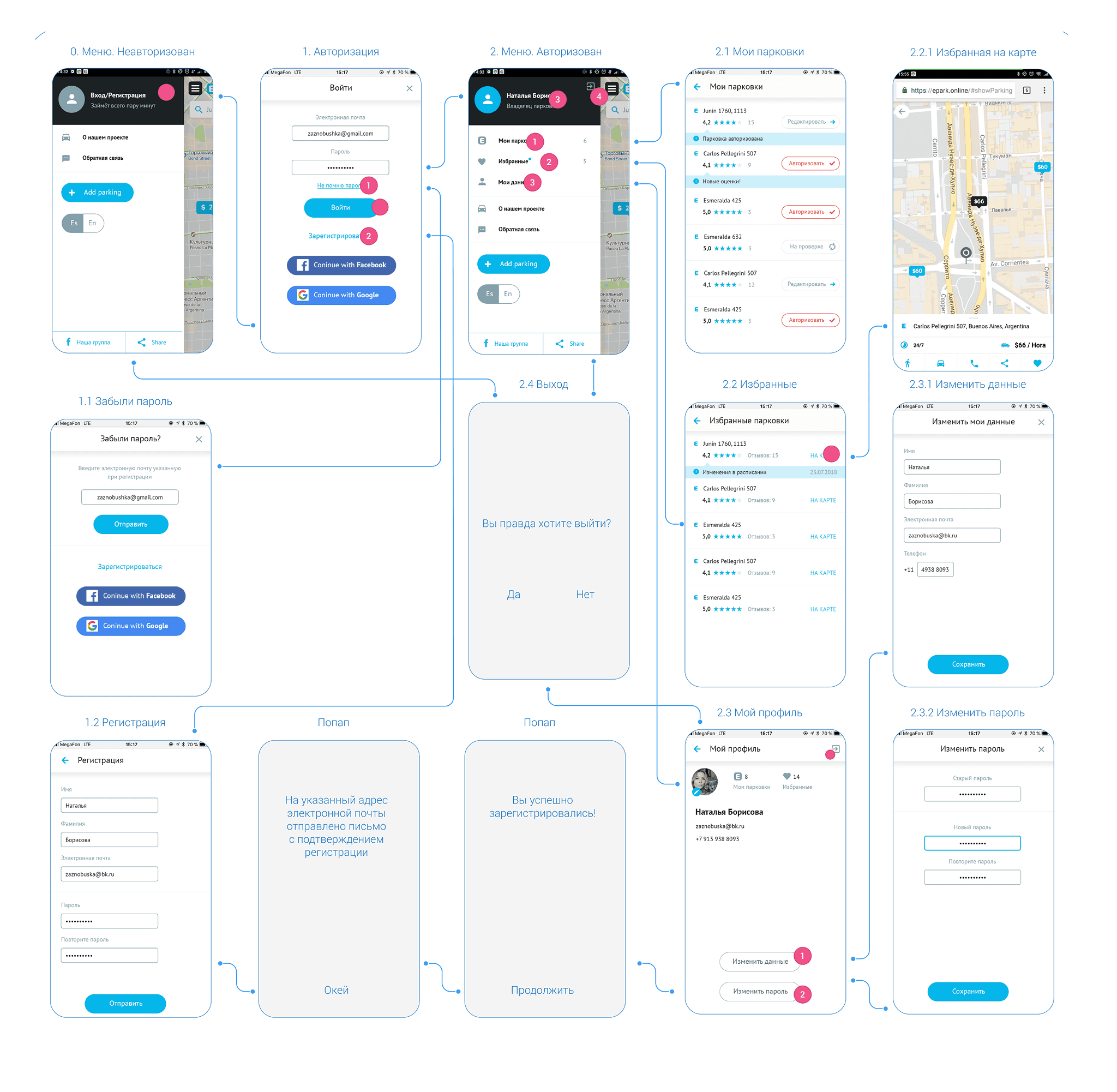
Product architecture
Role-based access logic
User flows
Interaction mapping (including annotated investor feedback)
UI system
Localization (Spanish)
Development supervision
Team size: 5 people.
The investor was based in Argentina and actively involved. We had frequent strategic disagreements, mainly around scope, cost, and timelines. Final architectural decisions were made collaboratively, with strong weight given to my product reasoning.
Key Product Decisions
1. One App Instead of Two
We intentionally avoided splitting the product into separate apps for drivers and parking owners in order to:
Reduce development costs
Simplify ecosystem growth
Maintain a unified platform logic
This required careful handling of permissions, states, and role transitions.
2. Feature Gating Strategy
Booking was available only for connected parking locations. However, the map was accessible for all listings.
This allowed us to:
Deliver value before full liquidity
Gradually scale supply
Avoid blocking launch due to incomplete onboarding
3. Ownership Verification Flow
Flow logic:
Location is created
Moderation review
Ownership verification via utility bill
Full management access granted
This reduced fraud risk without complex legal infrastructure.
4. Offline Integration
QR scanning connected digital booking with physical check-in.
We also developed:
Price boards (two formats)
Branded signage resembling official parking road signs
Printed leaflets and stickers for multiple audiences
The project extended beyond digital product design into urban navigation branding.


Constraints & Mistakes
No MVP phase — the product was designed as a full-scale solution from the start
Multiple redesigns occurred before my involvement
Parallel startup projects diluted focus
Budget reduction at final stage
Development transferred to a low-cost team
Core functionality was preserved.
However, final visual implementation quality did not meet the intended design standards (density, scaling inconsistencies).
What This Case Demonstrates
Multi-sided marketplace design
Role-based system architecture
Supply onboarding and moderation lifecycle
Offline-to-digital integration
Strategic decision-making under budget constraints
Direct collaboration with an investor-level stakeholder